Updated for 2026. Tax season has arrived again; if you’ve earned interest from a money market fund, a substantial portion of that interest might have originated from “US Government Obligations” like Treasury bonds and bills, which are typically exempt from state and local income taxes. To claim this exemption, you’ll probably need to manually input it on your tax return after gathering a few additional details.
Note: In California, Connecticut, and New York, dividend income is exempt only when the mutual fund meets specific minimum investment standards in U.S. government securities. These states require that at least 50% of a mutual fund’s assets at each quarter-end in the tax year be comprised of U.S. government obligations.
Vanguard recently published the U.S. government obligations income details for Tax Year 2025 [pdf] for its various funds, which states:
This tax update provides information to assist clients in correctly reporting state and local tax obligations on ordinary income distributions received from mutual fund investments in 2025.
The following page lists Vanguard funds that obtained a portion of their ordinary dividends from U.S. government obligations. Direct U.S. government obligations and certain agency obligations typically enjoy tax exemptions in most states.
To determine the portion of Vanguard dividends that might be exempt from your state income tax, multiply the “ordinary dividends” total reported in Box 1a of your Form 1099-DIV by the percentage noted in the PDF. Keep in mind that IRS Form 1099-INT has a special Line 3 for “Interest on US Savings Bonds & Treasury obligations.” However, Vanguard reports on 1099-DIV instead of 1099-INT; my Vanguard 1099-INT was all zeros.
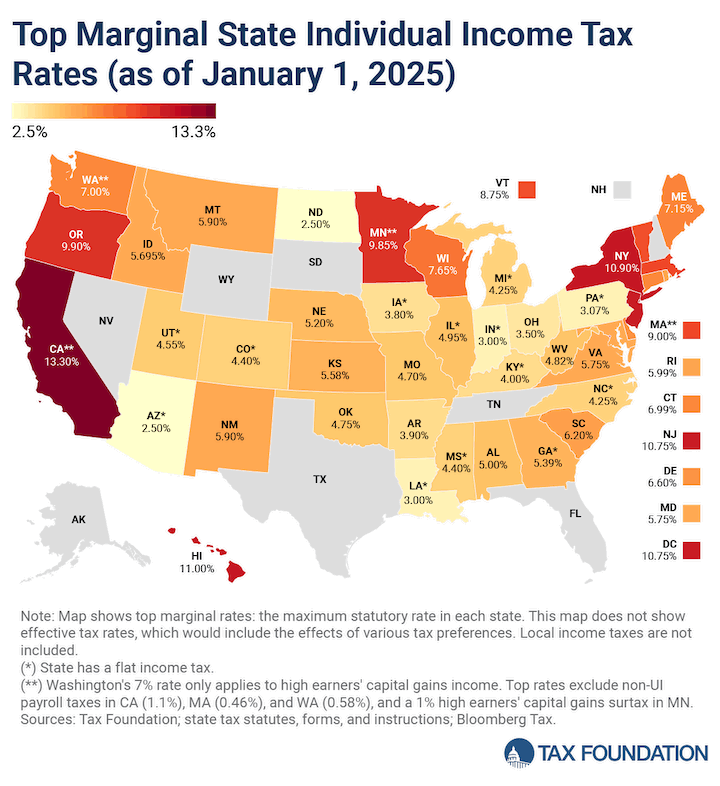
For the Vanguard Federal Money Market Fund (VMFXX), the exemption percentage was 66.61% in 2025. (For comparison, it was 59.87% in 2024 and 49.37% in 2023.) This means if you earned $1,000 in total interest from VMFXX in 2025, then approximately $666.10 could be exempt from state and local income taxes. If your marginal state income tax rate is 10%, that equates to about ~$67 in tax savings for every $1,000 of total interest. This fund met the threshold requirements for California, Connecticut, and New York in 2025, ensuring that 50% of its assets at each quarter-end throughout the tax year were invested in U.S. government obligations.
By contrast, the Vanguard Treasury Money Market Fund (VUSXX) showed a GOI percentage of 100% in 2025. (In 2024, it was also at 100% while in 2023, it was 80.06%.) Therefore, if your marginal state income tax rate is 10%, this could yield $100 in tax savings for each $1,000 of total interest earned.
The total income return for the Vanguard Federal Money Market Fund (VMFXX) was 4.22%, while the Vanguard Treasury Money Market Fund (VUSXX) was slightly higher at 4.23% over the 12-month period in 2025, indicating that the pre-tax returns were nearly identical. This is why many investors prefer manually transferring to VUSXX instead of opting for the default settlement fund, as it may result in a better after-tax interest rate.
(Why doesn’t Vanguard permit VUSXX as a cash sweep option? The frequent inflows and outflows associated with cash sweeps raise liquidity concerns, which may complicate holding everything in Treasury bonds. It’s conceivable that repurchase agreements are more liquid.)
The following Vanguard funds and their ETF equivalents derive 100% of their income from U.S. government obligations:
- 0-3 Month Treasury Bill ETF (VBIL)
- Ultra-Short Treasury ETF (VGUS)
- Short-Term Treasury Index Fund (VGSH, VSBSX)
- Intermediate-Term Treasury Index Fund (VGIT, VSIGX)
- Long-Term Treasury Index Fund (VGLT, VLGSX)
- Extended Duration Treasury Index Fund (EDV)
- Short-Term Inflation-Protected Securities Index Fund (VTIP, VTAPX)
- Inflation-Protected Securities Fund (VIPSX, VAIPX)
Several other Vanguard funds offer a smaller yet nonzero percentage of dividends stemming from U.S. government obligations, including the popular Vanguard Target Retirement 20XX funds (reaching up to 33-34% for Target Retirement 2020 and Target Retirement Income!). These may be particularly advantageous for residents facing high state/local tax rates, especially those nearing retirement who hold more bonds.
To access these tax savings, you will need to manually adjust your state and local income tax returns. I don’t believe TurboTax, H&R Block, or other tax software will automatically account for this, as they lack the necessary information. (It’s uncertain if they prompt for this in their interview process; you may need to navigate certain settings.) If you’re working with an accountant, be sure to verify that this information is applied correctly. Here’s a brief guideline on entering this into TurboTax:
- While entering the 1099-DIV Box 1a, 1b, and 2a – select the checkbox for “My form has info in other boxes (this is uncommon).”
- Next, choose the option indicating “A portion of these dividends is U.S. Government interest.”
- On the next screen, input the Government interest amount. This will be deducted from your state return.
Standard disclosure: Consult your state or local tax office or a tax advisor to confirm whether your state permits the exclusion of some or all income earned from mutual funds investing in U.S. government obligations.
[Image Credit – Tax Foundation]