Updated for 2026. As brokerage 1099 forms for the 2025 tax year are being issued, it’s an important reminder for those who are subject to state and/or local income taxes. If you earned interest from a money market fund, a considerable portion of this interest may have originated from “U.S. Government Obligations,” such as Treasury bills and bonds, which are generally exempt from state and local income taxes. To claim this exemption, however, you may need to manually enter this information on your tax return after gathering some additional details.
(Important Note: In California, Connecticut, and New York, dividend income is exempt only if the mutual fund meets certain minimum investments in U.S. government securities. Specifically, they require that 50% of a mutual fund’s assets, as of each quarter-end during the tax year, consist of U.S. government obligations.)
Fidelity has published the 2025 Percentage of Income from U.S. Government Securities [pdf]. Below are the results for some popular core Fidelity money market funds:
- Fidelity® Treasury Only Money Market Fund (FDLXX, CUSIP 31617H300) – 98.67%.
- Fidelity® Government Money Market Fund (SPAXX, CUSIP 31617H102) – 50.90%. *Did not meet the required minimum investment in U.S. Government securities for tax exemption in California, Connecticut, and New York.
- Fidelity® Government Cash Reserves (FDRXX, CUSIP 316067107) – 52.17%. *Did not meet the required minimum investment in U.S. Government securities for tax exemption in California, Connecticut, and New York.
- Fidelity® Treasury Money Market Fund* (FZFXX, CUSIP 316341304) – 61.52%. *Did not meet the required minimum investment in U.S. Government securities for tax exemption in California, Connecticut, and New York.
It is concerning that SPAXX, the default cash sweep option, did not meet the criteria to exempt any of their interest from state income tax in California, Connecticut, and New York. They must have fallen short of the 50% minimum threshold during one of the four quarters in 2025.
This situation is why I primarily invest in FDLXX as my “pseudo-core” money market fund through automated recurring purchases. For further details on this strategy, refer to my post titled “Fidelity Treasury Only Money Market (FDLXX) as Fidelity Core Position Workaround.”
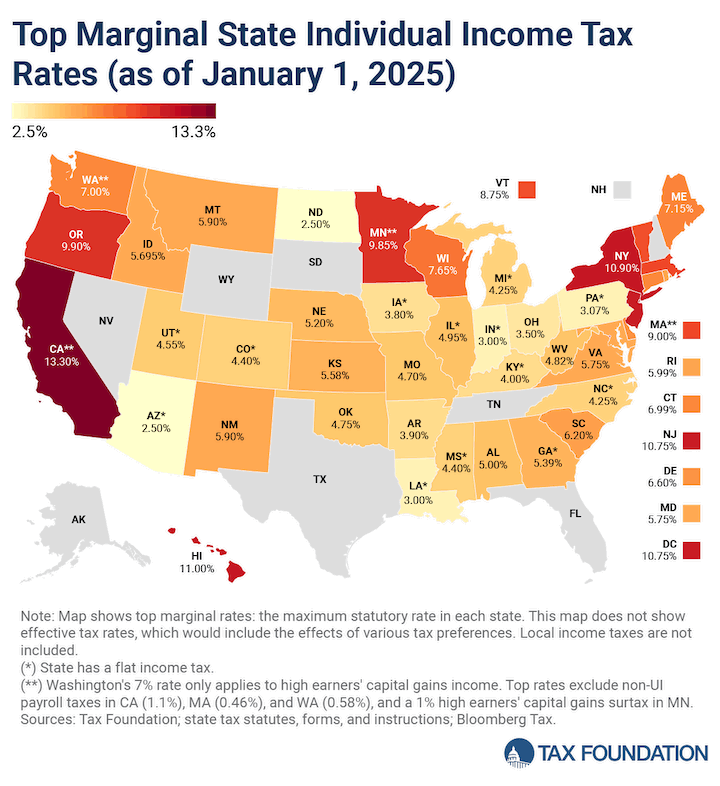
To determine the portion of your Fidelity dividends that may be exempt from state income tax, multiply the amount of “ordinary dividends” reported in Box 1a of your Form 1099-DIV by the percentage listed in the PDF. For instance, if you earned $1,000 in total interest from the Fidelity Treasury Only Money Market Fund (FDLXX) in 2025, then approximately $986.70 could potentially be exempt from state and local income taxes. If your marginal state income tax rate is 10%, that would equate to roughly $99 in tax savings for every $1,000 in total interest earned.
After accounting for taxes, individuals with an approximately 10% state income tax could find that FDLXX generates more interest than the default core holdings of SPAXX/FZFXX, even though the gross yield of SPAXX/FZFXX is higher than that of FDLXX.
To access these tax savings, you’ll need to manually adjust your state/local income tax return. I don’t believe tax software like TurboTax or H&R Block will automatically handle this for you, as they may lack the necessary information. Additionally, I’m unsure if they inquire about this during their client interviews. If you work with an accountant, be sure to verify that they incorporate this information. Here’s how you can enter this data in a previous version of TurboTax:
- When entering the details from your 1099-DIV for Box 1a, 1b, and 2a, select the checkbox for “My form has info in other boxes (this is uncommon).”
- Next, choose the option stating “A portion of these dividends is U.S. Government interest.”
- On the subsequent screen, input the Government interest amount, which will be subtracted from your state return.
Disclaimer: Consult with your state or local tax office or your tax advisor to determine if your state allows you to exclude some or all of the income earned from mutual funds that invest in U.S. government obligations.
[Image credit – Tax Foundation]